 China eBike
LFP vs NMC E-Bike Batteries: How Cell Chemistry Changes Pack Design
Compare LFP and NMC e-bike batteries by energy density, weight, voltage architecture, ageing, safety considerations and pack design.
The practical question in an LFP vs NMC e-bike battery comparison is rarely which chemistry is “better” in isolation. It is whether a particular battery pack can deliver the required range, fit the available space, keep removable weight manageable, work with the vehicle electronics and provide an acceptable service life.
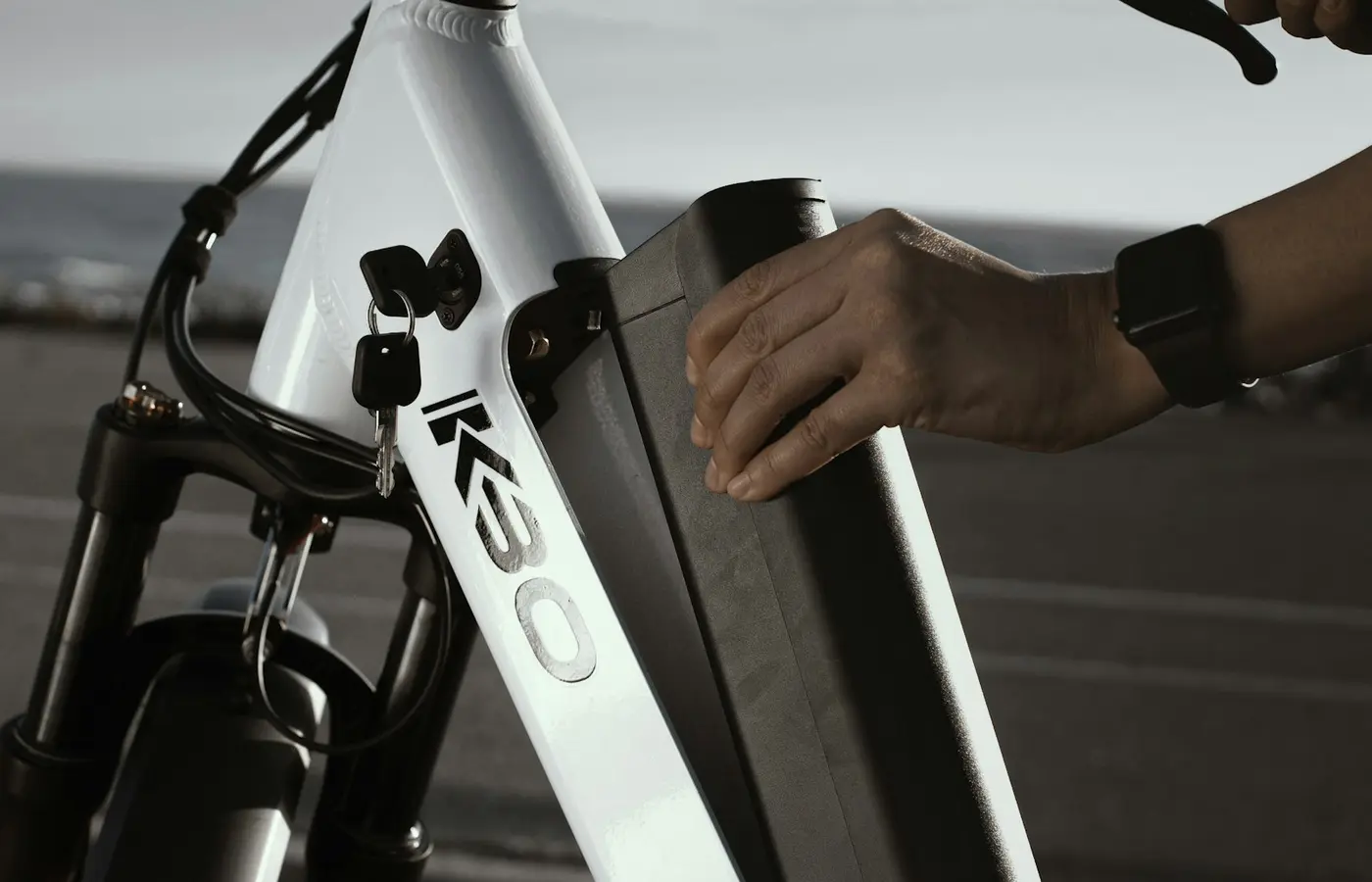
Lithium iron phosphate (LFP) and nickel-manganese-cobalt (NMC) cells can both be used in capable e-bike battery packs. Their different electrical and thermal characteristics, however, lead to different compromises in cell count, enclosure size, pack mass, charging equipment and expected ageing behaviour.
In broad terms, NMC is commonly selected when energy must fit into a compact and relatively light battery. LFP can be attractive where a larger or heavier pack is acceptable in exchange for favourable durability and thermal-stability characteristics. Neither conclusion removes the need to evaluate the complete pack: cells, wiring, battery-management system (BMS), enclosure, connectors, charger and vehicle integration all matter.
What LFP and NMC mean in an e-bike battery pack
LFP and NMC are both lithium-ion battery chemistries. The names refer primarily to the material used in the cell’s positive electrode, often called the cathode.
- LFP, also written as LiFePO4, uses lithium iron phosphate chemistry.
- NMC uses a cathode containing nickel, manganese and cobalt.
This chemistry label is useful, but incomplete. It does not identify the cell manufacturer, cell format, production quality, BMS calibration, waterproofing, charge limits or the quality of the pack assembler.
For example, two NMC packs with the same nominal watt-hour rating may use different cell sizes, nickel-manganese-cobalt ratios, parallel-cell counts, welding methods and BMS settings. The same applies to LFP packs. A chemistry name should therefore be treated as the start of a technical review, not as proof of pack quality or safety compliance.
A complete e-bike battery generally includes:
- individual cylindrical, pouch or prismatic cells;
- series and parallel electrical connections;
- a BMS that monitors voltage, temperature and current within its design limits;
- fuses, wiring and connectors;
- a mechanical enclosure and mounting system;
- a compatible charger; and
- sometimes communications hardware for the bike display or controller.
A failure in any of these elements can affect reliability or safety. Cell chemistry influences the design envelope, but it does not replace good pack engineering.
Energy density, mass and volume: equal watt-hours do not make equal packs
The most visible difference for many e-bike buyers is energy density. Energy density describes how much energy a cell can store for a given mass or volume. NMC-type cells generally offer higher energy density than LFP cells, which is why they are often used where battery weight and enclosure volume are tightly constrained. This broad trade-off is also described in commercial battery-industry comparisons such as RHY Energy’s overview of lithium-ion and lithium iron phosphate e-bike batteries.
For an e-bike, this has practical consequences:
- An NMC pack may provide a target energy capacity in a smaller downtube enclosure.
- An LFP pack with similar usable energy may need more physical space or add more mass.
- A rack-mounted LFP battery can affect rear load distribution and handling more noticeably than a lighter alternative.
- A larger removable pack may be less convenient to carry upstairs, bring indoors or lock to a bike.
The important comparison unit is watt-hours (Wh), not amp-hours alone.
Watt-hours combine voltage and capacity:
Watt-hours = nominal voltage × amp-hours
Two packs can both be labelled with the same amp-hour figure while storing different amounts of energy if their nominal voltages differ. Since LFP and NMC cells commonly operate at different voltage ranges, comparing only amp-hours can be misleading.
Likewise, two packs with the same watt-hour label may not deliver identical real-world range. Usable energy depends on BMS cut-off settings, controller demand, rider mass, terrain, temperature, tyre pressure, assist mode and cell ageing. A higher-energy-density chemistry helps reduce mass or volume, but it does not eliminate these variables.
Why pack-level specifications matter more than cell-level claims
Cell data sheets can show the potential of an individual cell. The e-bike buyer, importer or OEM still needs pack-level figures:
| Check | Why it matters |
|---|---|
| Nominal watt-hours | Provides a more meaningful energy comparison than amp-hours alone. |
| Battery mass | Affects carrying, handling and vehicle weight distribution. |
| External dimensions | Determines whether the pack fits a downtube, rack, cargo box or custom enclosure. |
| Continuous and peak discharge limits | Must suit the controller’s current demand. |
| Charge voltage and charge current limits | Must match the supplied charger and BMS configuration. |
| Environmental protection details | Helps assess whether the enclosure is appropriate for the intended use. |
A high-quality NMC cell does not automatically produce a light pack if the enclosure is oversized or the BMS is poorly selected. Conversely, a carefully engineered LFP pack may be a sensible choice where weight is secondary to daily throughput and service life.
Voltage architecture and electronics compatibility
Cell chemistry affects pack voltage architecture because LFP and NMC cells have different nominal voltages and different charge and discharge voltage limits.
To build a battery for a target e-bike system voltage, a manufacturer connects cells in series. More cells in series increase voltage. Cells are also connected in parallel to increase capacity and current capability.
Because LFP cells typically have a lower nominal cell voltage than NMC cells, an LFP pack commonly needs a different series-cell count to reach a similar nominal system voltage. That changes the pack’s full-charge voltage, low-voltage behaviour and BMS configuration.
This is why an LFP conversion is not normally a drop-in replacement for an NMC battery, even when both products are marketed for the same nominal e-bike voltage class.
Before changing chemistry, verify all of the following:
- the controller’s permitted input-voltage range;
- the controller’s low-voltage cut-off behaviour;
- the charger’s output voltage and charging profile;
- the BMS’s cell count and balancing configuration;
- connector type, polarity and current rating;
- discharge-current capability of the replacement pack;
- physical fit, mounting security and cable routing; and
- any communication protocol between battery, display and controller.
A mismatch can cause incomplete charging, overcharging risk, unexpected shut-off, reduced battery life or damage to electronics. Reusing an existing charger simply because its connector fits is not a safe compatibility test.
State of charge is also a system-design issue
Voltage is often used as one input for estimating battery state of charge. LFP’s discharge-voltage behaviour can be relatively flat through much of its operating range, which can make voltage-only charge displays less informative. A well-designed BMS and display system may use current counting and other inputs, but capability varies by product.
For riders, this means that a battery gauge should be treated as an estimate. For OEMs and importers, it means charge-display accuracy should be checked at the pack-and-vehicle level rather than assumed from chemistry alone.
Durability, charging habits and real-world ageing
LFP is widely associated with strong cycle-life potential. NMC can also provide useful service life, but published cycle-life claims must be read carefully because test conditions vary substantially.
A cell maker’s cycle-life figure may depend on:
- charge and discharge current;
- depth of discharge on each cycle;
- operating temperature;
- maximum charge voltage;
- minimum discharge voltage;
- rest periods between cycles; and
- the stated end-of-life capacity threshold.
A result obtained under moderate laboratory conditions cannot be assumed to represent a high-power e-bike used daily on steep hills, stored in summer heat and frequently charged immediately after hard riding.
In practice, both chemistries age faster when exposed to unfavourable conditions such as persistent high temperature, repeated high-current operation, unsuitable charging voltage or prolonged storage at extreme states of charge. Cell quality and manufacturing consistency also matter. A poor-quality LFP pack is not automatically longer-lived than a well-designed NMC pack.
For fleet operators, delivery riders and cargo-bike users, the possibility of longer useful service life can make LFP worth investigating if the vehicle can accommodate the additional mass or volume. For a folding e-bike, lightweight commuter bike or compact integrated-battery frame, NMC may better satisfy the packaging requirement even if the owner expects to replace the pack sooner.
Better battery-care habits apply to both chemistries
Battery-care guidance should ultimately come from the vehicle or battery manufacturer, but several principles are broadly relevant:
- Use the charger specified for the exact battery pack.
- Avoid charging a damaged, swollen, unusually hot or water-contaminated battery.
- Allow a heavily used pack to return toward normal temperature before charging when the manufacturer advises it.
- Store the battery in a dry location away from excessive heat and direct sunlight.
- Follow the manufacturer’s storage state-of-charge guidance for periods when the bike will not be used.
- Do not bypass a BMS, fuse or temperature sensor to solve a performance problem.
Safety and thermal behaviour: chemistry is not the whole safety case
LFP is generally regarded as having stronger thermal and chemical stability than NMC. That characteristic can provide useful thermal margin in pack design, particularly where batteries see frequent cycling, warm climates or demanding duty cycles.
However, “more thermally stable” does not mean that an LFP pack cannot fail, overheat or catch fire. Mechanical damage, manufacturing defects, internal shorts, water ingress, poor welding, counterfeit cells, inappropriate chargers and failed protection electronics can create hazards in battery packs of either chemistry.
NMC is not inherently unsuitable for e-bikes. It is widely used in energy-dense battery applications, including compact e-bike packs. Its use requires the same fundamentals expected of any lithium-ion battery: authentic cells, suitable electrical protection, correct charging limits, robust mechanical design and appropriate quality control.
Chemistry also should not be confused with a certification or regulatory status. A pack labelled LFP or NMC is not automatically certified for transport, compliant with a local product rule, water resistant or approved for a particular market. Those questions require the supplier’s relevant pack-level documentation and the applicable regulations in the destination market.
For importers, a useful distinction is:
- Chemistry-level information describes what the cells are designed to do.
- Pack-level test and compliance documentation concerns the actual product being sold.
- Vehicle-level compliance concerns how the battery, motor, controller and complete e-bike meet local rules together.
These documents should not be substituted for one another.
Choosing an LFP or NMC pack for an e-bike project
The right choice starts with vehicle requirements rather than a preference for a chemistry label.
NMC is often worth prioritising when
- removable-battery weight is a major buying criterion;
- the frame has limited battery volume;
- a compact integrated downtube pack is required;
- handling and centre-of-mass targets leave little room for added battery mass; or
- the vehicle needs the highest practical energy storage within a fixed enclosure.
LFP is often worth investigating when
- the vehicle can accept a larger or heavier battery enclosure;
- daily energy throughput is high and long service life is an important commercial consideration;
- thermal margin is a major design objective;
- the bike is a cargo, utility, fleet or stationary-adjacent application where pack size is less restrictive; or
- the supplier can provide a complete, compatible pack rather than a chemistry-only conversion.
For buyers comparing Chinese e-bike battery suppliers, request documentation for the actual proposed pack, not merely a generic chemistry brochure. At minimum, ask for:
- the cell manufacturer and exact cell model;
- a cell data sheet with electrical limits and test conditions;
- pack nominal voltage, watt-hours, mass and dimensions;
- series and parallel configuration where appropriate for the procurement review;
- BMS charge, discharge, temperature and protection limits;
- charger output specification and connector details;
- continuous and peak discharge capability;
- enclosure, mounting and ingress-protection information where claimed;
- warranty terms and stated exclusions; and
- applicable test, transport or market-compliance records for the finished pack.
Frequently asked questions
Is LFP safer than NMC in an e-bike battery?
LFP is generally associated with stronger thermal and chemical stability at the cell-chemistry level. That does not make every LFP pack safe by default, nor does it make NMC packs inherently unsafe. Pack assembly, BMS operation, charger compatibility, cell authenticity, mechanical protection and user handling materially affect safety in both cases.
Why is an LFP e-bike battery usually heavier than an NMC battery with similar capacity?
For similar watt-hours, LFP cells generally store less energy per kilogram and per unit of volume than NMC cells. An LFP pack may therefore need more cell mass or more physical space to store the same nominal energy. Compare watt-hours, mass and dimensions rather than amp-hours alone.
Can I replace an NMC e-bike battery with an LFP battery?
Not without verifying the complete electrical and mechanical system. The replacement must be compatible with the controller voltage range, charger output, BMS settings, low-voltage cut-off, connectors, mounting system and current demand. A nominal voltage label alone is not enough to confirm compatibility.
Does LFP always last longer than NMC?
No. LFP has strong cycle-life potential, but pack life depends on cell quality, temperature, charge limits, discharge rate, depth of discharge, storage conditions and BMS design. Published cycle counts should only be compared when the test conditions and end-of-life criteria are equivalent.
Practical takeaway
Choose NMC when the e-bike project is constrained by battery mass or enclosure volume. Consider LFP when the design can accept a larger pack and places particular value on cycle-life potential and thermal stability.
The final decision should be made from verified pack-level documentation, not a chemistry label. Compare usable watt-hours, mass, dimensions, voltage window, current limits, BMS configuration, charger compatibility and warranty conditions before selecting either architecture.