 China eBike
How Long Does an E-Bike Battery Take to Charge? A Practical Estimate
Estimate e-bike battery charging time using watt-hours, charger output and starting charge level, with practical caveats for tapering.
The useful question is not simply how many hours an e-bike battery takes to charge. It is how long your battery will take from its current charge level with its specified charger.
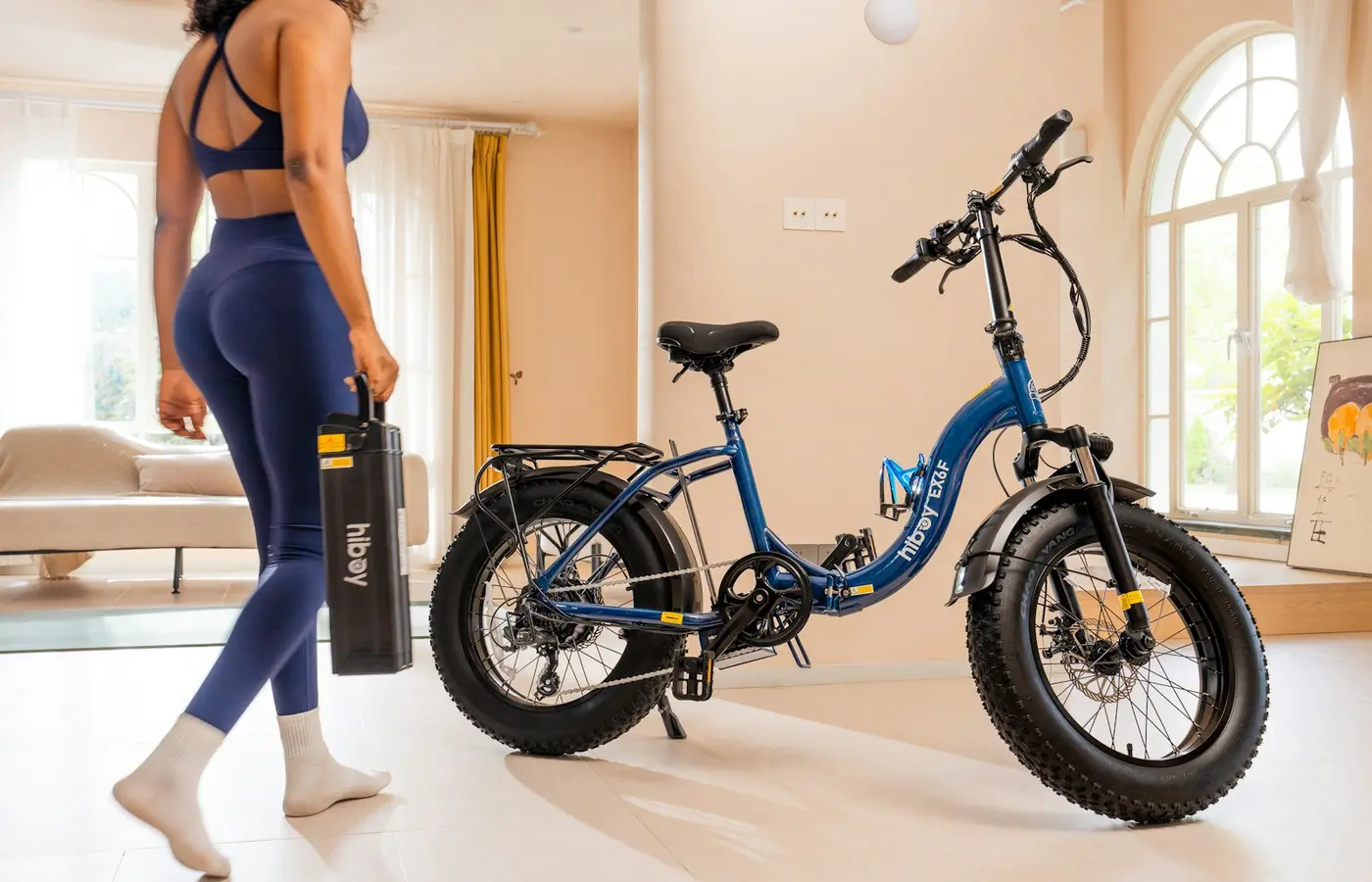
A compact battery paired with a higher-output approved charger may be ready relatively quickly. A larger pack, or a battery that is nearly empty, can take much longer. The final part of charging also commonly takes longer than a simple division calculation suggests.
You can still make a practical estimate with the labels already on the battery and charger. Start with battery capacity in watt-hours (Wh), identify charger output in watts (W), calculate the energy missing, then allow additional time for the slower final phase.
Start with the battery and charger labels
Look for the battery label, the charger label, or the bicycle’s manual. The most useful specifications are:
- Battery capacity in watt-hours (Wh): The clearest measure of how much energy the pack stores.
- Battery voltage and capacity in amp-hours (Ah): Often shown as a pair, such as 36V 14Ah or 48V 15Ah.
- Charger output voltage and current: Usually printed in a format such as
Output: 42V ⎓ 2A. - Charger output power in watts: Some chargers state this directly. If not, it can be estimated by multiplying the output voltage by output current.
Do not confuse the charger input rating with its output rating. A charger may list an AC input range for the wall outlet, but that figure does not tell you how much DC power reaches the battery. For a charging-time estimate, use the DC output voltage and current.
Also distinguish the battery’s nominal voltage from the charger’s output voltage. A battery described as 36V may use a charger marked 42V, while a nominal 48V pack may use a charger marked 54.6V. Those values can be normal for their respective battery systems; the charger output is selected for the battery’s full-charge voltage.
Use only the charger specified or explicitly approved for the battery system. Matching a connector alone is not sufficient evidence that a charger is compatible.
The quick charging-time formula
The basic calculation is:
Estimated ideal charging time (hours) = energy to replace (Wh) ÷ charger output (W)
First calculate the energy that is missing:
Energy to replace (Wh) = battery capacity (Wh) × fraction of charge missing
For example, if a 500Wh battery is approximately 40% charged, about 60% of its rated capacity is missing:
500Wh × 0.60 = 300Wh to replace
If its approved charger is rated at 84W, the idealized calculation is:
300Wh ÷ 84W = about 3.6 hours
That is a planning estimate, not a promised finish time. Power drawn from the wall is not identical to energy stored in the cells, and the charger may not deliver its maximum rated output continuously throughout the session. Charging also usually slows near full charge.
A more realistic way to use the formula is to treat it as the lower-bound calculation, then leave extra time if you need the battery fully charged. Do not add a fixed universal percentage: the difference depends on the particular battery, charger, temperature, starting condition, and charging controls.
Estimate from amp-hours when watt-hours are not listed
If the battery label shows voltage and amp-hours but not watt-hours, calculate nominal energy capacity as follows:
Nominal watt-hours (Wh) = nominal battery voltage (V) × capacity (Ah)
For a 48V 15Ah battery:
48V × 15Ah = 720Wh nominal capacity
Next, estimate charger output power:
Charger output power (W) = charger output voltage (V) × output current (A)
A charger labelled 54.6V 2A has a stated maximum output of approximately:
54.6V × 2A = 109.2W
Using the ideal calculation, a fully depleted 720Wh battery would be:
720Wh ÷ 109.2W = about 6.6 hours
Again, that result excludes the effects of tapering and other real-world limits, so it should not be read as an exact full-charge time.
The simpler Ah divided by A method
Where the battery and charger are correctly matched, riders sometimes use this shortcut:
Approximate time (hours) = battery capacity (Ah) ÷ charger current (A)
For a 15Ah battery and a 2A charger:
15Ah ÷ 2A = 7.5 hours
This can be useful for a quick comparison between chargers, but it is still an approximation. It assumes the labelled current is available through most of the charge and does not account for the reduced current commonly seen near full charge. The Wh-and-W method is usually clearer when comparing batteries with different voltages.
Worked examples: small, typical, and high-capacity packs
The following examples are hypothetical. They show the method rather than promising a specific charge time for any particular e-bike.
| Battery and starting point | Charger output | Ideal calculation | Practical reading |
|---|---|---|---|
| 360Wh battery, empty | 42V 2A = about 84W | 360 ÷ 84 = about 4.3 hours | Expect longer than the ideal figure if charging to full. |
| 500Wh battery, 40% charged | 42V 2A = about 84W | 300 ÷ 84 = about 3.6 hours | A useful estimate for replacing the missing 60%, with extra time near full. |
| 1,000Wh battery, empty | 54.6V 3A = about 164W | 1,000 ÷ 164 = about 6.1 hours | A large pack can still require a long charging window even with a higher-output charger. |
The key comparison is energy divided by power. A 1,000Wh pack has roughly twice the stored energy of a 500Wh pack, so it will generally require about twice as much charging time when the charger output is unchanged.
Published brand guidance often illustrates this same relationship by pairing different battery sizes with different charger-current options, but quoted figures should be treated as model-specific rather than universal.1
Why the last part of the charge takes longer
Lithium-ion battery charging is generally managed in stages. Early in a charge cycle, the system can often supply a higher current. As the battery approaches its intended full-charge voltage, the charging system limits voltage and reduces current.
This is commonly described as a constant-current phase followed by a constant-voltage phase. In plain terms, the first part of the charge can add energy relatively quickly, while the final portion takes progressively longer.
That does not mean every e-bike begins slowing at exactly 80%, or at any other fixed percentage. The point and shape of the taper depend on the battery pack, its battery management system (BMS), charger design, cell condition, and operating temperature.
For planning purposes, the practical implication is straightforward: a calculation based on the charger’s rated maximum watts is most useful for the earlier and middle part of the session. If you need a full battery by a set departure time, allow a margin rather than relying on the calculated figure alone.
Other reasons real charging times differ from the estimate
The formula gives a useful baseline, but several variables can move the actual result in either direction.
Starting state of charge
A battery at 50% needs roughly half as much energy replaced as an empty battery of the same rated capacity. This is the largest and easiest variable to account for.
Battery percentage displays are themselves estimates. If the bike only uses bars or a simple indicator, treat the calculated starting percentage as approximate.
Temperature
Battery systems may restrict charging when the pack is too cold or too warm. The permitted charging temperature range, if specified, should come from the battery or bicycle manual. Do not assume that a battery will accept its normal charging current in all conditions.
Battery management system limits
The BMS monitors the battery and may limit or stop charging under certain conditions. Its behavior varies by system. If a battery charges more slowly than expected, the manual and the charger’s status indicators are better starting points than assuming a fault or attempting to override the system.
Charger, cable, port, and battery condition
A damaged charger, cable, connector, or charge port can affect charging or create a safety concern. Follow the manufacturer’s instructions if any equipment is damaged, unusually hot, or showing an unexpected indicator pattern. Do not attempt to compensate for a suspected problem with a higher-output or unverified charger.
Charging on or off the bicycle
Some e-bike batteries can be charged either installed on the bicycle or removed; others have manufacturer-specific procedures. This choice does not automatically make charging faster. Follow the instructions for the particular battery, including any requirements for connection order, location, or battery removal.
Can a higher-amp charger charge an e-bike faster?
Potentially, but only when the battery manufacturer explicitly approves that charger for the exact battery system.
A charger with a higher current rating can reduce the ideal calculation because its output power is higher. For example, at the same output voltage, a 4A charger is rated for roughly twice the output power of a 2A charger. That does not establish that the battery, BMS, charge port, wiring, or thermal design is approved for the higher current.
Do not select a charger based only on voltage, connector shape, or an online claim that it is compatible. An unapproved substitute may have the wrong charge-voltage profile, polarity, communication behavior, or current capability for the battery.
Frequently asked questions
How long does a 500Wh e-bike battery take to charge?
It depends on how empty it is and on charger output. With an 84W charger, a completely empty 500Wh pack produces an ideal calculation of about 6 hours (500Wh ÷ 84W). A battery at 40% charge needs approximately 300Wh replaced, producing an ideal calculation of about 3.6 hours. In both cases, allow additional time for the final charging phase.
Can I calculate e-bike charging time from amp-hours and charger amps?
Yes, approximately. Divide battery capacity in Ah by charger current in A, provided the charger is specifically matched to that battery system. For a more comparable estimate across different voltage systems, first convert the battery to Wh and the charger to W.
Why does my e-bike battery charge slowly after about 80%?
The charging system commonly reduces current as the battery approaches full charge. The exact percentage at which this becomes noticeable is not universal. It may also be affected by battery temperature and the BMS.
Can I use a higher-amp charger to charge my e-bike faster?
Only if the bicycle or battery manufacturer explicitly approves that charger and current rating for your battery. Do not assume that a physically matching plug or a matching nominal voltage makes a higher-current charger suitable.
A practical charging-time checklist
Before planning a charge, work through these steps:
- Find the battery’s Wh rating, or calculate nominal Wh from volts multiplied by Ah.
- Find the charger’s DC output voltage and current, then multiply them to estimate output watts if necessary.
- Estimate the fraction of battery capacity that is missing.
- Divide missing Wh by charger W for an ideal baseline.
- Add time for tapering near full charge and for any manufacturer-defined charging limits.
- Use the specified or explicitly approved charger, and follow the battery maker’s instructions for charging conditions and equipment inspection.
The result will be more useful than a generic charging-time claim because it is based on the battery, charger, and current charge level that actually matter.